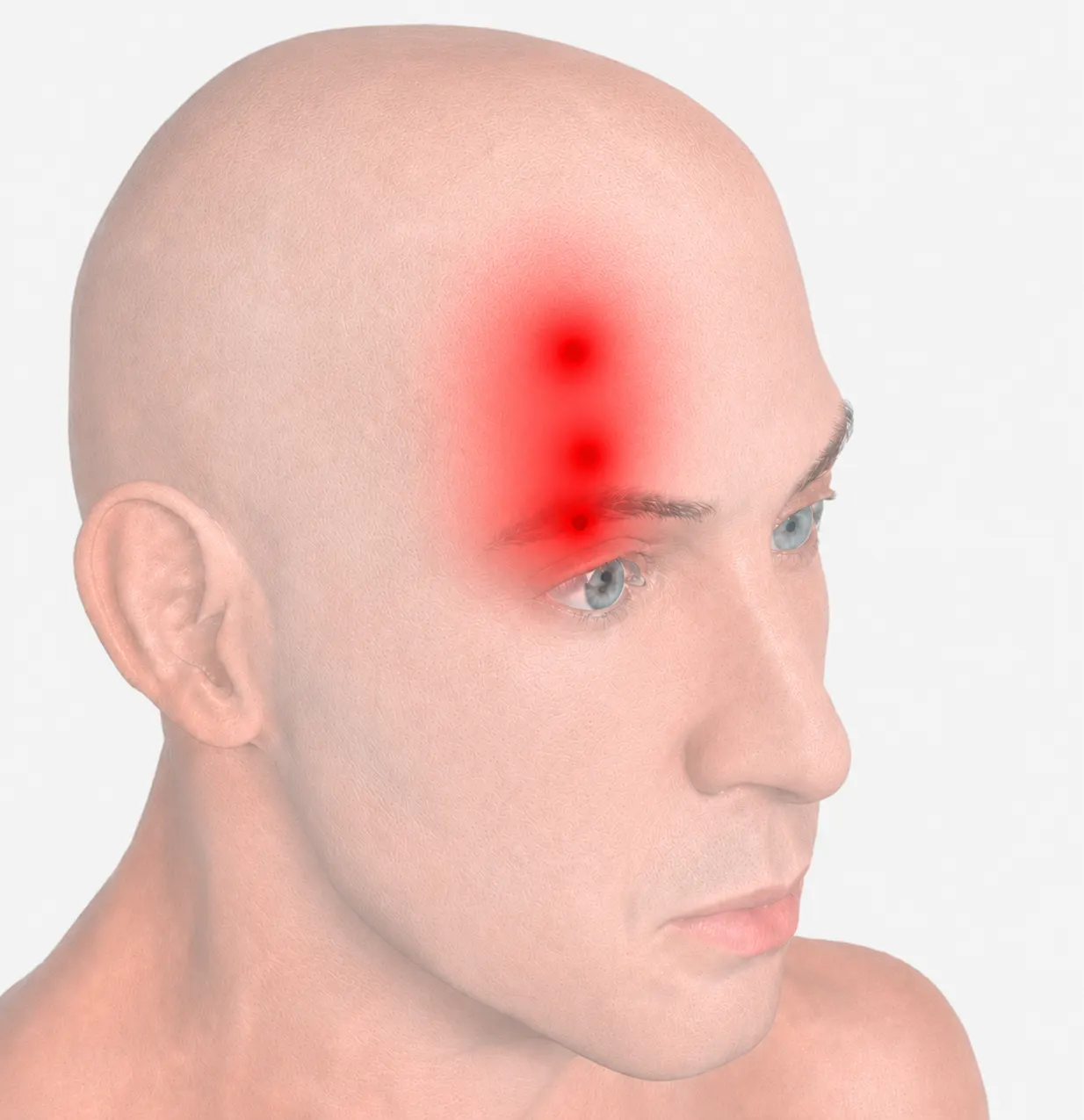
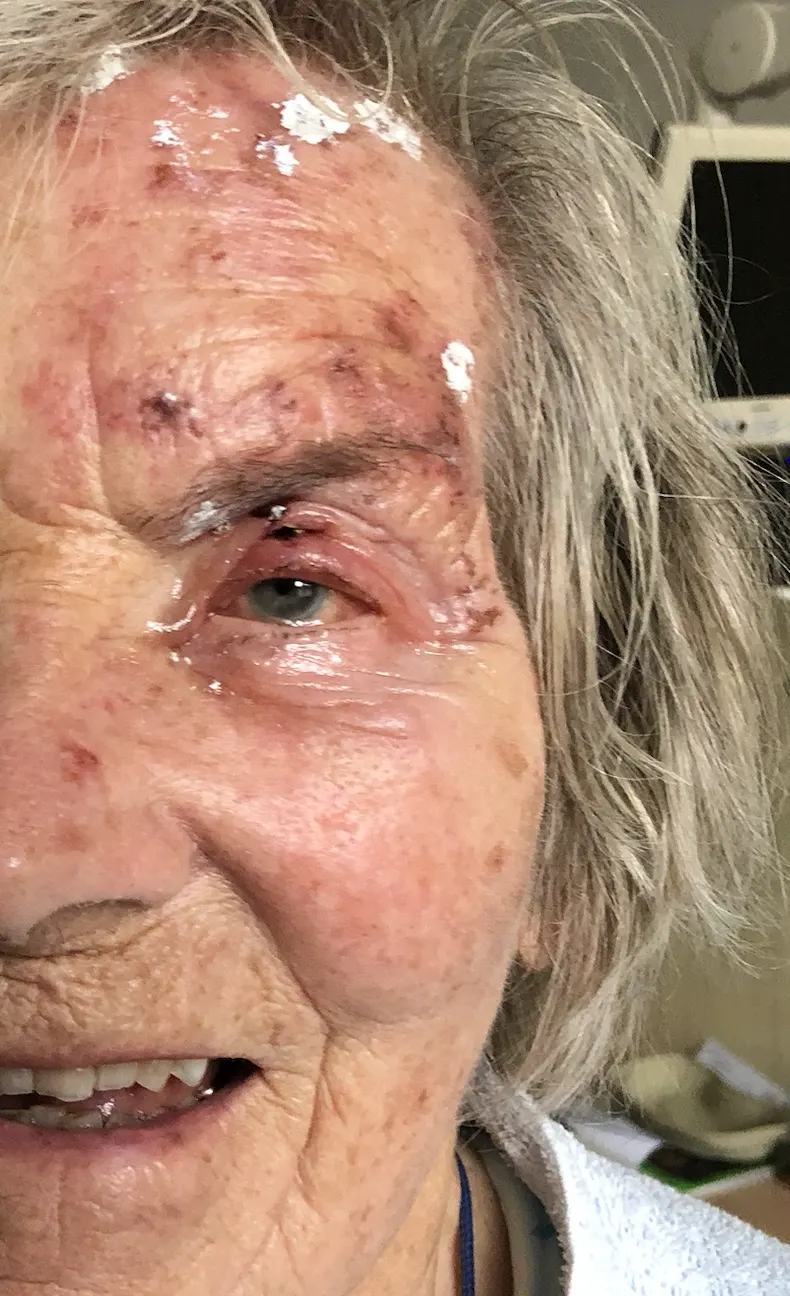
Burning, with touch sensitivity.
Persistent burning or stabbing pain in the former rash area, often with distressing itching and allodynia — even slight contact (clothing, wind) is perceived as painful.
After shingles in the area of the first trigeminal branch, severe pain attacks appeared at first, then a distressing itch, burning and painful touch sensitivity remained over the forehead and the upper eyelid — despite guideline-compliant drug therapy for several months. Initial improvement appeared after the second Axomera therapy; after a total of eight sessions, the symptoms only occur occasionally, are hardly disturbing, and the patient is free of medication.
Documented individual case, with the patient's consent. Individual progress differs.
After shingles (herpes zoster), nerve pain can persist even though the skin rash has long healed. Involvement of the first trigeminal branch (V1) — the eye-forehead region — is particularly common and particularly distressing.
Persistent burning or stabbing pain in the former rash area, often with distressing itching and allodynia — even slight contact (clothing, wind) is perceived as painful.
In the head area, shingles predominantly affects the trigeminal nerve, and there in turn most frequently the first branch (V1) — forehead, upper eyelid and scalp on one side.
The pain can persist for months to years; the risk of postherpetic neuralgia increases significantly with advancing age.
Postherpetic neuralgia (PHN) is defined as pain associated with herpes zoster (HZ) that persists beyond the acute skin eruption and is considered its most common complication. In patients ≥50 years, an estimated 12.5% develop PHN three months after the onset of zoster, with a significantly increasing proportion in older age. Cervical HZ most frequently involves the trigeminal nerve (about 58% of head cases); its ophthalmic branch (herpes zoster ophthalmicus, HZO) accounts for 2.5–20% of all HZ cases and is accompanied by an additional risk of ocular complications (keratitis, uveitis, optic neuritis). Conventional therapy includes early antiviral treatment of the acute zoster episode as well as, in established PHN, tricyclic antidepressants, gabapentinoids, topical lidocaine/capsaicin and interventional procedures (pulsed radiofrequency, nerve blocks); effectiveness remains only partial in many cases.
Evidence base, nuanced: For standard oral therapy (tricyclic antidepressants, gabapentin, pregabalin), several placebo-controlled RCTs and Cochrane meta-analyses with moderate quality of evidence are available. For interventional procedures specifically for trigeminal/V1-PHN — pulsed radiofrequency, nerve blocks — the data is significantly weaker: predominantly case reports and small, heterogeneous case series without a control group; dedicated randomised studies on trigeminal PHN are largely missing, and pulsed radiofrequency is considered low-quality evidence in current HTA assessments overall.
Gharibo C, Kim C. Postherpetic Neuralgia and Trigeminal Neuralgia. Pain Ther, PMC5735631. — Bhala BB et al. Pulsed Radiofrequency of the Trigeminal Ganglion for Treating Postherpetic Neuralgia of the Ophthalmic Branch. PMC8189809. — Gilden D et al. Trigeminal Postherpetic Neuralgia: From Pathophysiology to Treatment. PMC10940365. — Kedar S et al. Eruption severity and characteristics in herpes zoster ophthalmicus: correlation with visual outcome, ocular complications, and postherpetic neuralgia. PMID 19416378. — Javier J et al. Pulsed Radiofrequency for Postherpetic Trigeminal Neuralgia: A Case Report. Cureus 2022;14(9):e28913. — Wiffen PJ et al. Gabapentin for chronic neuropathic pain in adults. Cochrane Database Syst Rev 2017;CD007938 (moderate-quality evidence for PHN).Tricyclic antidepressants and gabapentinoids often only provide partial relief, and interventional procedures such as pulsed radiofrequency are poorly evidenced, particularly in cases involving V1.
Following shingles, the affected nerve remains hypersensitive along its entire course — even light touch to the skin triggers pain (allodynia). The former rash area, involving the forehead and upper eyelid in V1 cases, is exposed and precisely accessible from the outside.
Axomera targets this hypersensitive skin area: computer-controlled electrical signals in the dimension of cellular electrical fields are placed with millimetre precision in the affected nerve region. The goal is to raise the skin's sensory threshold and alleviate itching and allodynia — we typically expect a response within one to six sessions.
Classification: This neurophysiological hypothesis is empirically supported by many patient progressions (real-world data), not by controlled trials. As with other indications, about 20–30 % of those treated do not respond.
We consciously frame this as a goal, not a therapeutic guarantee. The success of the therapy depends on the individual case, which we discuss openly before starting treatment.
Inflammation has an electrical dimension. Axomera starts exactly there.
Axomera is an internationally patented bioelectrical procedure.
How Axomera therapy works →Developer of Axomera therapy · Medical Director
As the developer of Axomera therapy, he oversees the indication and is involved in your treatment personally upon request. His experience in conservative pain medicine informs the planning of your treatment series.
Doctor, orthopaedics & trauma surgery (in specialist training)
Performs your Axomera treatment and accompanies you throughout the entire treatment series. He reviews your findings and assesses whether the procedure is suitable for you. He also participates in the technical development.
Doctor, Specialist in Orthopaedics and Trauma Surgery
Organises your previous findings, performs Axomera diagnostics, and accompanies you throughout the entire treatment series. He reviews your findings and, based on his experience, assesses whether the procedure is suitable for you.
Three ways to reach us, around the clock, directly here on the site. For each, you can upload doctor's letters, findings, and MRI images at the same time — encrypted into your file, reviewed by a doctor before we speak.
Ten minutes with a doctor. Free of charge.
Medical assessment via video.
Examination, Axomera diagnostics, plan, costs.
Prefer personal contact? Call: +49 211 866880
Our practice treats exclusively by prior appointment.
The telephone initial assessment is not a treatment and does not replace an examination. Whether Axomera is suitable for you will be decided after a medical examination.