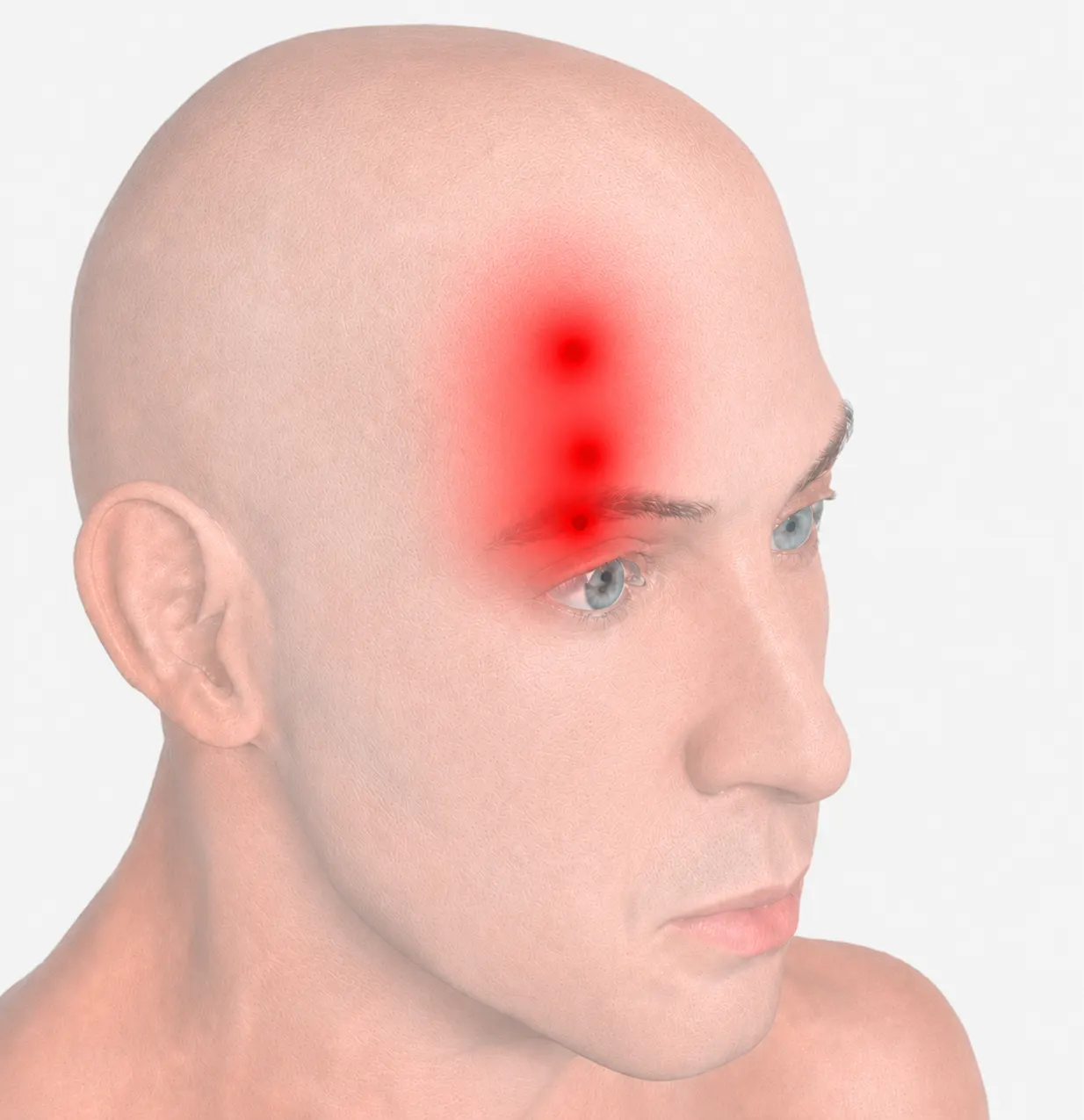
Slightly longer than trigeminal neuralgia.
The attacks are slightly longer than in trigeminal neuralgia, but still short — and localized exclusively in the eye-forehead area.
SUNCT stands for Short-lasting Unilateral Neuralgiform headache attacks with Conjunctival injection and Tearing and belongs to the trigeminal autonomic cephalalgias.
The attacks are slightly longer than in trigeminal neuralgia, but still short — and localized exclusively in the eye-forehead area.
Typical are ipsilateral conjunctival injection (eye redness) and tearing during the attacks — hence the "CT" in the name.
SUNCT shows a very high attack frequency and is often treatment-refractory — one of the most difficult headache conditions of all.
The largest prospective series to date (Cohen et al., n=43 SUNCT/SUNA) shows attack-wise conjunctival injection and tearing with consistently short, high-frequency attacks. Classic antiepileptics (standard therapy for trigeminal neuralgia) are often significantly less effective in SUNCT; lamotrigine is considered the comparatively most tolerable option in the literature, but a consistent response is not guaranteed. The disease remains treatment-refractory in a relevant proportion of cases.
Cohen AS, Matharu MS, Goadsby PJ. SUNCT and SUNA — a prospective clinical study. Brain 2006;129(10):2746–60. PMID 16905753. — Pareja JA, Caminero AB, Sjaastad O. SUNCT syndrome: diagnosis and treatment. CNS Drugs 2002;16(6):373–83. PMID 12027784. — Costa A et al. Review of pharmacological treatment. Curr Neuropharmacol 2015;13(3):304–23. PMID 26411963.Paroxysmal hemicrania resembles cluster headache, but occurs in shorter, yet more numerous attacks throughout the day.
Attacks of 2 to 30 minutes, but more than five per day — significantly more frequent than in cluster headache.
Like in cluster: eye redness, tearing, blocked or runny nose, eyelid swelling — in each case on the pain side.
A complete disappearance of symptoms under indomethacin is part of the diagnosis itself — without this response, the diagnosis is not considered confirmed.
Indomethacin is considered standard therapy and usually provides a complete response within hours to a few days at the correct dosage; a treatment trial with a sufficiently high dose (up to 150 mg/day for 3–4 days) simultaneously serves to confirm the diagnosis. A relevant proportion of those affected, however, do not tolerate indomethacin long-term — gastrointestinal and neuropsychiatric side effects are common; alternatives (COX-2 inhibitors, melatonin, non-invasive vagus nerve stimulation) show effect in smaller series, but none with the reliability equivalent to indomethacin.
Bahra A. Paroxysmal hemicrania and hemicrania continua: review on pathophysiology, clinical features and treatment. Cephalalgia 2023. — Villar-Martínez MD et al. Indomethacin-responsive headaches — a narrative review. Headache 2021. — Henningsen MJ et al. Epidemiology and clinical features of paroxysmal hemicrania: a systematic review and meta-analysis. Headache 2024;64(1):5–15. — Kamourieh S, Lagrata S, Matharu MS. Non-invasive vagus nerve stimulation is beneficial in chronic paroxysmal hemicrania. J Neurol Neurosurg Psychiatry 2019;90(9):1072–4.In hemicrania continua, there is a unilateral continuous headache — without a symptom-free interval, but with superimposed, stronger bouts.
Unlike in cluster, SUNCT, and paroxysmal hemicrania, there are no attack-free phases — the pain is present throughout, usually of moderate intensity, with episodic aggravations.
During the bouts, as with the other trigeminal autonomic cephalalgias, eye redness, tearing, or a runny nose occur on the pain side.
Most courses are continuous (chronic) from the beginning; a remitting form with symptom-free phases is rarely described. This headache also reacts to indomethacin.
Even with Hemicrania continua, almost complete response to indomethacin is part of the diagnostic definition (Sjaastad & Spierings 1984). As with paroxysmal hemicrania, gastrointestinal and neuropsychiatric side effects limit long-term intake for a relevant proportion of those affected; COX-2 inhibitors, melatonin and non-invasive vagus nerve stimulation are discussed as alternatives, with limited evidence to date.
Sjaastad O, Spierings EL. Hemicrania continua: another headache absolutely responsive to indomethacin. Cephalalgia 1984;4:65–70. — Bahra A. Paroxysmal hemicrania and hemicrania continua: review on pathophysiology, clinical features and treatment. Cephalalgia 2023. — Villar-Martínez MD et al. Indomethacin-responsive headaches — a narrative review. Headache 2021.In SUNCT, the response to medication is often limited, and indomethacin is not tolerated long-term by a relevant proportion of those affected due to gastrointestinal or neuropsychiatric side effects.
These rare, trigeminal autonomic headache forms share an irritated trigeminal loop in the eye-forehead area which—unlike cluster headache—usually maintains itself without longer symptom-free phases. The trigeminal endpoint at the forehead and eye is accessible from the outside for Axomera therapy.
Axomera acts at this accessible point: computer-controlled electrical signals in the dimension of cellular electrical fields are placed with millimetre precision in the eye-forehead area of the trigeminal nerve. The goal is to raise the irritation threshold of the loop. We have not observed any worsening of the clinical picture in this process.
Classification: This neurophysiological hypothesis is empirically supported by many patient progressions (real-world data), not by controlled trials. As with other indications, about 20–30 % of those treated do not respond.
How inflammation and pain are connected →We treat one level deeper — where the body regulates inflammation and healing itself.
Axomera is an internationally patented bioelectrical procedure.
How Axomera therapy works →Developer of Axomera therapy · Medical Director
As the developer of Axomera therapy, he oversees the indication and is involved in your treatment personally upon request. His experience in conservative pain medicine informs the planning of your treatment series.
Doctor, orthopaedics & trauma surgery (in specialist training)
Performs your Axomera treatment and accompanies you throughout the entire treatment series. He reviews your findings and assesses whether the procedure is suitable for you. He also participates in the technical development.
Doctor, Specialist in Orthopaedics and Trauma Surgery
Organises your previous findings, performs Axomera diagnostics, and accompanies you throughout the entire treatment series. He reviews your findings and, based on his experience, assesses whether the procedure is suitable for you.
Three ways to reach us, around the clock, directly here on the site. For each, you can upload doctor's letters, findings, and MRI images at the same time — encrypted into your file, reviewed by a doctor before we speak.
Ten minutes with a doctor. Free of charge.
Medical assessment via video.
Examination, Axomera diagnostics, plan, costs.
Prefer personal contact? Call: +49 211 866880
Our practice treats exclusively by prior appointment.
The telephone initial assessment is not a treatment and does not replace an examination. Whether Axomera is suitable for you will be decided after a medical examination.