axomera
Cluster headache — pain distribution, periorbital concentration
Cluster headache

The most severe pain a human can endure.

Daily medication, desperate doctor visits with no prospects.. As a reference centre for Axomera therapy, we have been treating cluster headache for years and pursue a different goal than pure attack suppression: the longest possible remission, with as little long-term medication as possible.

Medical content overseen by Prof. Dr. med. Albrecht Molsberger · reviewed 10/2026

Pain distribution · Cluster · according to Schröder et al. 2021
Patients report

People with a long history of suffering — in their own words.

Case 01 / 05
I have had cluster headache for around 20 years, continuously chronic since 2012. Most recently, I had about two attacks a day, with devastating pain of severity 10, despite high-dose verapamil prophylaxis and triptans. After four Axomera treatments in twelve days, I have remained symptom-free ever since.
Patient · cluster headache (chronic)

Sustained freedom from symptoms after four treatments in twelve days.

Patient · chronic cluster headache, approximately a 20-year history — a clearly labelled individual case.

From the practice's records, with consent. A personal experience, not a treatment promise.

Documented individual cases, with patient consent. Individual outcomes differ.

Is Axomera right for me? Initial telephone assessment →
Why patients come to us

We know your path.

Many of our patients have years behind them: misdiagnoses, emergency room visits in the middle of the night, triptans up to the limit of application, ever-new prophylaxis regimens — and the feeling of not being taken seriously with their own pain.

We carefully check your history first before we suggest Axomera therapy. As a reference centre for the method, patients travel from all over Germany, Austria, and Switzerland for this — especially for cluster headache.

Patients

What patients report.

Typical findings

From our patient consultations and the medical reports submitted.

  • Attacks of 15–180 minutes, up to 8 times daily, often at night
  • Strictly unilateral pain around or behind the eye — often described as the most severe pain imaginable
  • Accompanied by eye redness, tearing, blocked nose, pronounced restlessness
  • Episodic or chronic progression, frequently over many years
  • High-dose prophylaxis (e.g. verapamil) with noticeable side effects
Previous therapy

Almost always in this order.

  1. Acute therapy: oxygen via mask and triptans as an injection or nasal spray
  2. Prophylaxis: verapamil, gradually up to high dose ranges (with ECG monitoring)
  3. Bridging: short-term cortisone or nerve blocks on the greater occipital nerve
  4. Escalation: lithium, topiramate, or monoclonal antibodies
  5. For chronic, treatment-refractory progression: neuromodulation (vagus nerve, occipital nerve, or sphenopalatine ganglion stimulation)
Clinical picture

What cluster headache is — and what it is not.

01 · Characteristics

Attack-like, unilateral, extremely severe.

Cluster attacks typically affect one side of the head, concentrated behind and around the eye. Patients frequently describe the pain as the most severe imaginable. Accompanied by eye redness, tearing, a runny or blocked nose on the same side, and pronounced restlessness — many cannot sit or lie down during an attack.

02 · Episodic vs. chronic

Two very different progressions.

Episodic cluster headaches occur preferably in spring and autumn. Episodes typically last 6–12 weeks with 1–8 attacks daily, followed by remissions often lasting several months. About 10–15% of those affected develop a chronic form without sufficient remission phases — either primarily chronic or as an "evolved" form from a previously episodic progression.

03 · Differentiation

Clean diagnostics — primary or secondary.

Before therapy comes clear classification: primary headache or secondary cause (imaging to exclude). Important differential diagnoses include, in particular, trigeminal neuralgia and SUNCT syndrome. We record previous findings, imaging, and attack patterns and compare them with ICHD criteria — before we talk about therapy options.

04 · Our offer

Diagnostic review & second opinion.

If you are unsure whether the diagnosis or the previously chosen therapy fits your situation: we examine previous findings in a structured manner and provide a specialist second opinion. Even if, in the end, a treatment other than Axomera is the appropriate one.

Request second opinion →
Your medical team

Who treats you.

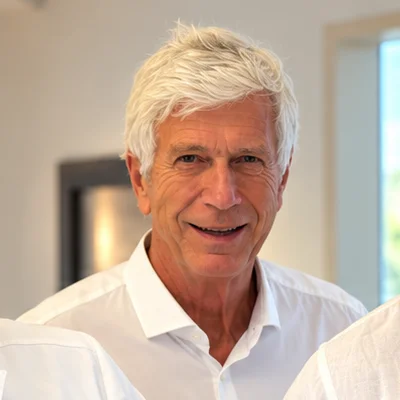
Medical team at Axomera Practice Düsseldorf: Dr. med. Philipp Schröder, Prof. Dr. med. Albrecht Molsberger and Jonas Becker
From left to right
  • Dr. med. Philipp SchröderDoctor, orthopaedics & trauma surgery (in specialist training)
  • Prof. Dr. med. Albrecht MolsbergerSpecialist in orthopaedics
    Medical Director
  • Jonas BeckerSpecialist in orthopaedics and trauma surgery

Prof. Molsberger developed Axomera therapy and published research on cluster headache together with the cell biologist Colin McCaig (J Pain Res 2020). At the reference centre, you are treated by the medical team led by Prof. Molsberger.

Cluster headache — what is conventionally possible

Our approach

How we proceed with you.

Every therapy needs its own examination — for us, this includes the Axomera diagnostics and the Axomera therapy.

Axomera diagnostics
  1. Secure diagnosis (attack pattern, imaging, exclusion of secondary causes) and check previous medication
  2. Millimetre-precise examination — localising the periorbital and trigeminal pain points
Axomera therapy
  1. 4–6 Axomera treatments — with chronic progression also more densely timed, targeted at these points
  2. Goal: significant reduction in attack frequency and intensity
  3. In favourable progressions: return to an episodic pattern with longer, preferably permanent, remission phases

Aimed goals. We cannot guarantee a specific result — progressions are individual.

Where we make the difference

Axomera for cluster headache

In cluster headache, the hypothalamus is considered the central pacemaker, which triggers the characteristic attacks via a trigeminal autonomic reflex loop. This self-activating loop runs via the inflamed, irritated trigeminal branches with painful endpoints in the area of the forehead, eye, jaw, and neck. These endpoints are accessible from the outside for Axomera therapy.

Axomera is a neuromodulative procedure: computer-controlled electrical signals in the dimension of cellular electrical fields are placed millimetre-precisely at these accessible points. The goal is to raise the irritation threshold of the trigeminal autonomic loop — and thus to interrupt the self-stabilising attack rhythm. The number and intensity of the attacks decrease.

How inflammation and pain are connected →

The goal is relief — in a favourable case, a remission. How far this succeeds depends on the individual progression.

„
Inflammation has an electrical dimension. Axomera starts exactly there.
Prof. Dr. Albrecht Molsberger
— Prof. Dr. Albrecht Molsberger · Developer of Axomera therapy, medical director

Axomera is an internationally patented bioelectrical procedure.

How Axomera therapy works →
Our own contributions to research

We do not just apply the method — we research it.

As a reference centre, we ourselves contribute to the scientific basis of cluster headache. Two peer-reviewed studies in which we were involved are central to this: a first-time mapping of where cluster pain originates, and an evaluation of how patients respond to bioelectric stimulation.

Where cluster pain begins — mapped for the first time.

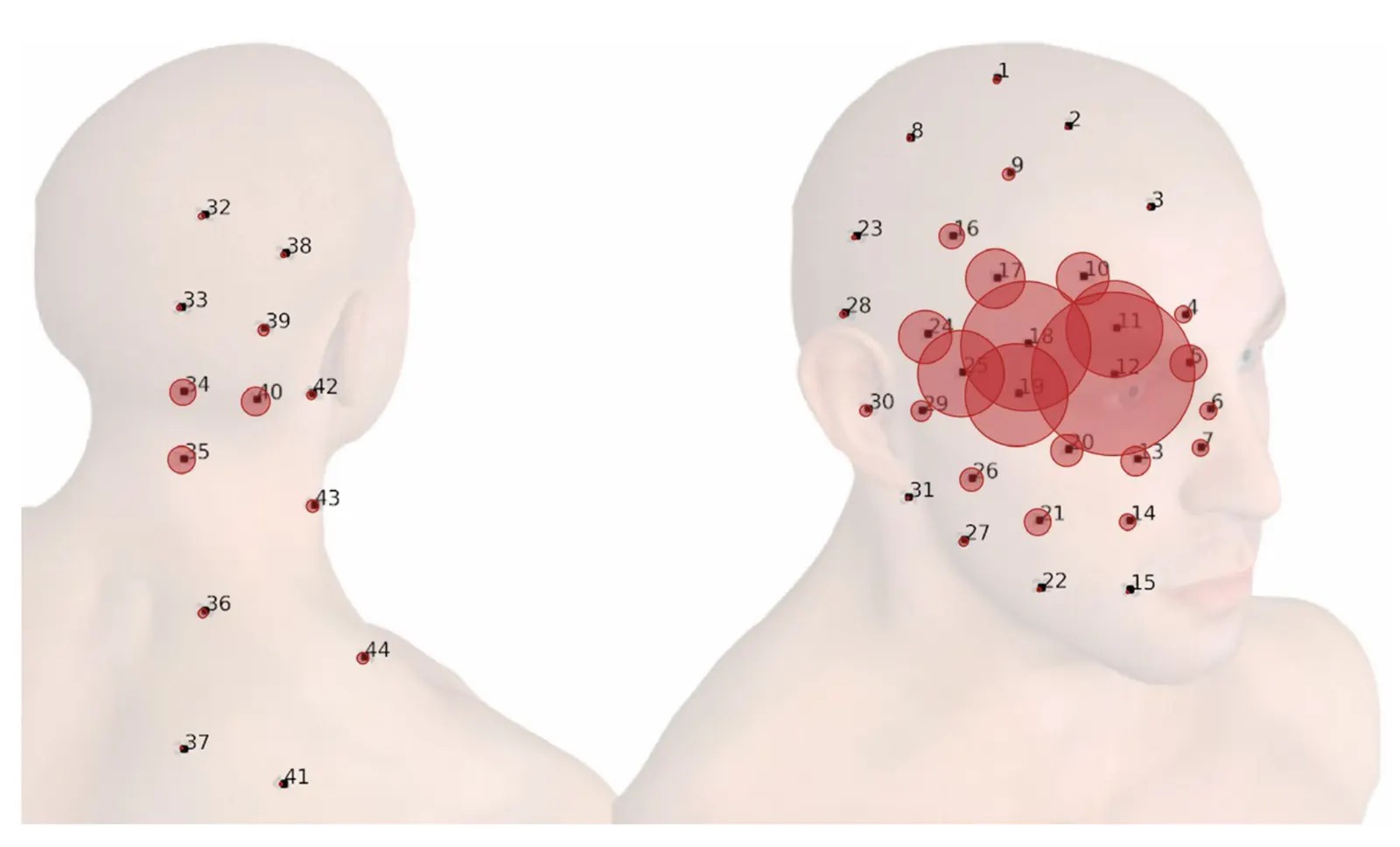
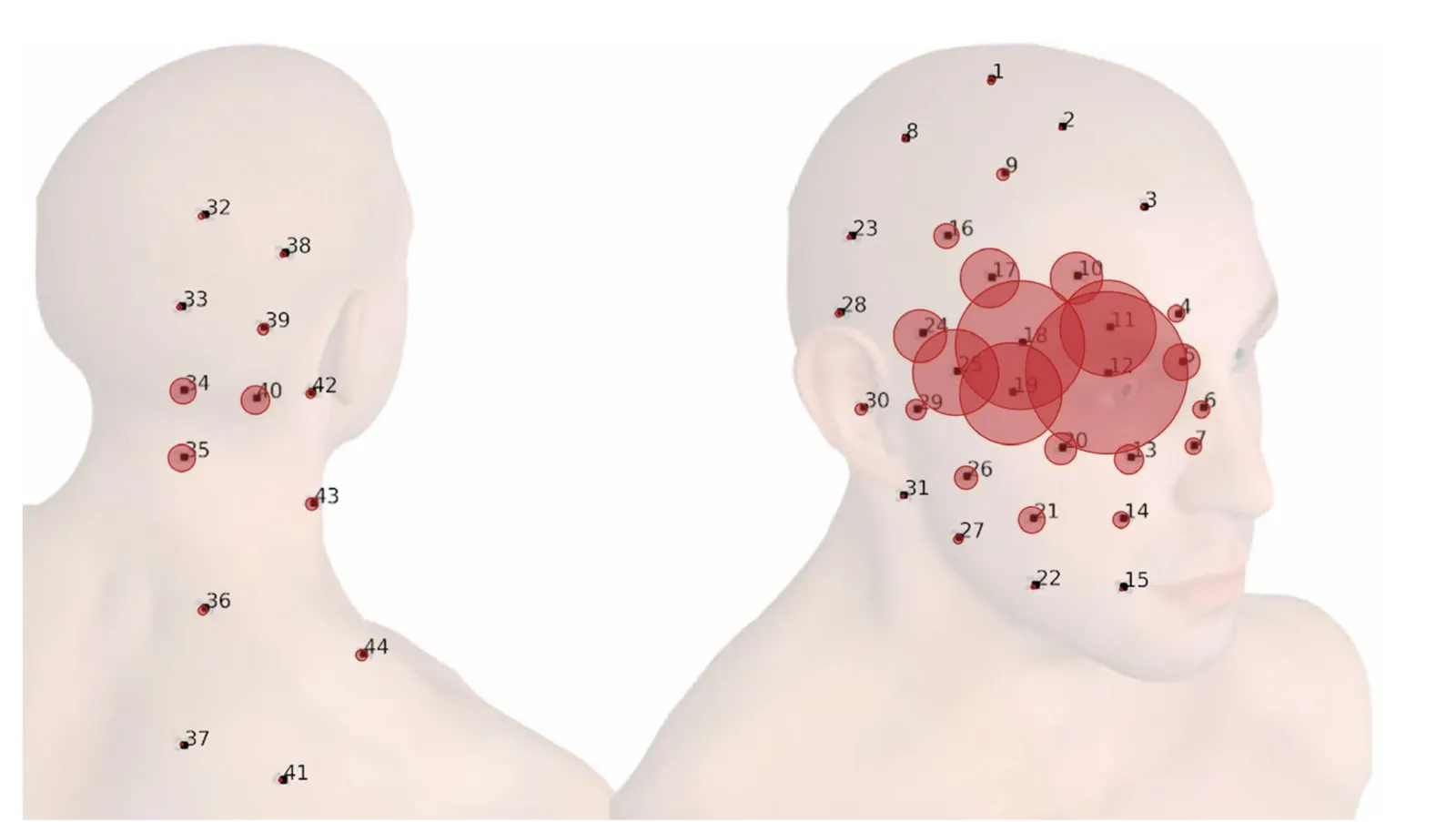
Until now, cluster pain has been broadly classified as being "behind the eye". Our work has, for the first time, broken down the pain according to the timing of the attack — separating the onset, the peak, and the radiation. The result: at onset and peak, the pain is concentrated around the eye socket; however, certain points outside of this — especially in the neck and the lower jaw area — occur more frequently at the beginning of the attack than at its peak. This map provides the anatomical basis for targeting treatment early and precisely. The evaluation is based on a large dataset: 5,260 individual reports on 44 pain locations from 631 affected individuals.

Schröder P, Gaul C, Drabik A, Molsberger A. Pain localization in cluster headache patients: onset, peak, and radiation. Acta Neurol Scand 2021. PMID 33523462. DOI
Pain locations in cluster headache — head from behind and from the side, 44 recorded points
ORIGINAL DATA · SCHRÖDER ET AL. 2021 · 44 RECORDED PAIN POINTS

Circle size = frequency of mention. Largest concentration periorbital/temporal (right side of head); the highlighted point on the lower jaw (left side of head, point 40) appeared notably frequently even at the onset of an attack.

Periorbital / temporal — strongest concentration (onset & maximum)
Lower jaw & neck/occipital — more frequent even at attack onset

Published case series — Axomera in 20 chronic cluster patients.

In our retrospective case series of 20 chronic cluster patients (2014–2018), the average number of attacks per day fell from 2.8 to 1.7 after four weeks, and from 2.2 to 0.7 for the 14 responders; after one year, 13 out of 20 patients showed a reduction of at least 50%, ten of whom were attack-free.

Classification: hypothesis-generating retrospective case series, not a controlled study.

Complete remission over 2 years50 %
Improvement of more than 50%63 %
No effect30 %*

* Of 6 non-responders, 4 had previously undergone surgery. Individual clinical courses differ.

Molsberger A, McCaig CD. Percutaneous Bioelectric Current Stimulation for Chronic Cluster Headache — A Possible Transformative Approach. J Pain Res 2020;13:817–828. PMID 32425586. DOI

Current: Scientific case description

Chronic relapsing cluster — 6 years symptom-free after 5 Axomera treatments.

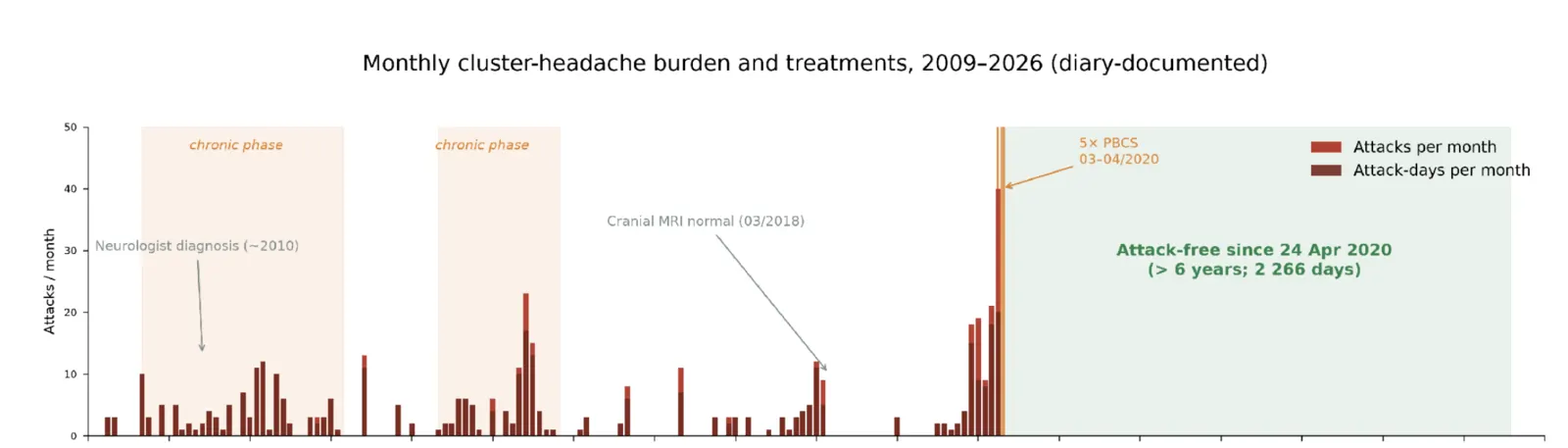
A German patient in his early 60s had suffered since 1996 from a strictly left-sided, chronic relapsing cluster headache. Over the course of the illness, he received 41 cortisone pulse therapies while on continuous verapamil prophylaxis; imaging was unremarkable. Acute treatment was provided with oxygen and triptans each time. His last episode in 2020 was the most treatment-resistant over nine months. It escalated to intravenous prednisolone (1000 mg) without benefit. After 9 more days of the most intense attacks, Axomera therapy was started with five sessions at weekly intervals (occipital and trigeminal target points). Following this, the average attack intensity was halved, severe attacks disappeared, and the episode ended abruptly — last attack on 23 April 2020, after the fourth session.

The case has been submitted for publication in a peer-reviewed scientific-medical journal.

Explanation of the case by the treating physician.

Monthly cluster course 2009–2026: attacks/month and attack days/month, with chronic phases, MRI findings, 5× PBCS 03–04/2020 and sustained remission since 24 April 2020
Attack diary 2009–2026: after 5 PBCS treatments (03–04/2020) sustained remission — attack-free since 24 April 2020, for over 6 years (2,266 days).
Your treatment team

Who treats you.

Your practitioners
Prof. Dr. med. Albrecht Molsberger

Prof. Dr. med. Albrecht Molsberger

Developer of Axomera therapy · Medical Director

As the developer of Axomera therapy, he oversees the indication and is involved in your treatment personally upon request. His experience in conservative pain medicine informs the planning of your treatment series.

Career history
  • Specialist in Orthopaedics; additional qualifications in Sports Medicine, Acupuncture, Naturopathy
  • Habilitation 2005, adjunct professorship for Orthopaedics at Ruhr University Bochum
  • Conception and management committee of the GERAC studies (German Acupuncture Trials)
  • Development of Axomera therapy since 2008
Dr. med. Philipp Schröder

Dr. med. Philipp Schröder

Doctor, orthopaedics & trauma surgery (in specialist training)

Performs your Axomera treatment and accompanies you throughout the entire treatment series. He reviews your findings and assesses whether the procedure is suitable for you. He also participates in the technical development.

Career history
  • Doctor, orthopaedics & trauma surgery (in specialist training); medical degree, Heinrich Heine University Düsseldorf, 2020
  • Doctorate magna cum laude, Ruhr University Bochum (2021): Pain localisation in cluster headache
  • Expert courses in Ultrasound in Pain Medicine (DEGUM curriculum, level I); Expert course in Sports Medicine
  • Technical co-development of Axomera therapy; co-founder of Columbus Health-Products GmbH
Further practitioner
Jonas Becker

Jonas Becker

Doctor, Specialist in Orthopaedics and Trauma Surgery

Organises your previous findings, performs Axomera diagnostics, and accompanies you throughout the entire treatment series. He reviews your findings and, based on his experience, assesses whether the procedure is suitable for you.

Contact · Online reception

Clarify first. Then travel.

Three ways to reach us, around the clock, directly here on the site. For each, you can upload doctor's letters, findings, and MRI images at the same time — encrypted into your file, reviewed by a doctor before we speak.

01 · Telephone

Briefly check if it's a fit.

Ten minutes with a doctor. Free of charge.

  • ·For those who are unsure
  • ·Upload findings beforehand
  • ·No obligation
Select phone appointment →
02 · Video

Consultation on findings without the travel.

Medical assessment via video.

  • ·For patients traveling from further away
  • ·Second opinion before making a decision
  • ·According to GOÄ, amount visible upon booking
Book video appointment →
03 · Practice

Everything in one appointment.

Examination, Axomera diagnostics, plan, costs.

  • ·For all who wish to visit
  • ·The direct route for distances up to about 100 km
  • ·Bring or upload findings
Book appointment →

Are you traveling from further away? Start with 01 or 02. Only when it is clear that Axomera is suitable for you do we plan the journey — condensed into a few days. Available internationally as a concierge service upon request.

Prefer personal contact? Call: +49 211 866880

Our practice treats exclusively by prior appointment.

The telephone initial assessment is not a treatment and does not replace an examination. Whether Axomera is suitable for you will be decided after a medical examination.