axomera
Disc & sciatica

Localising the radiating nerve pain precisely.

When a herniated disc presses on the nerve root, the pain can shoot into the leg or the arm — and often remains, even after the acute phase has passed. As a reference centre for Axomera therapy, we examine the painful region of the inflamed nerve very precisely in Düsseldorf and use Axomera therapy in suitable cases.

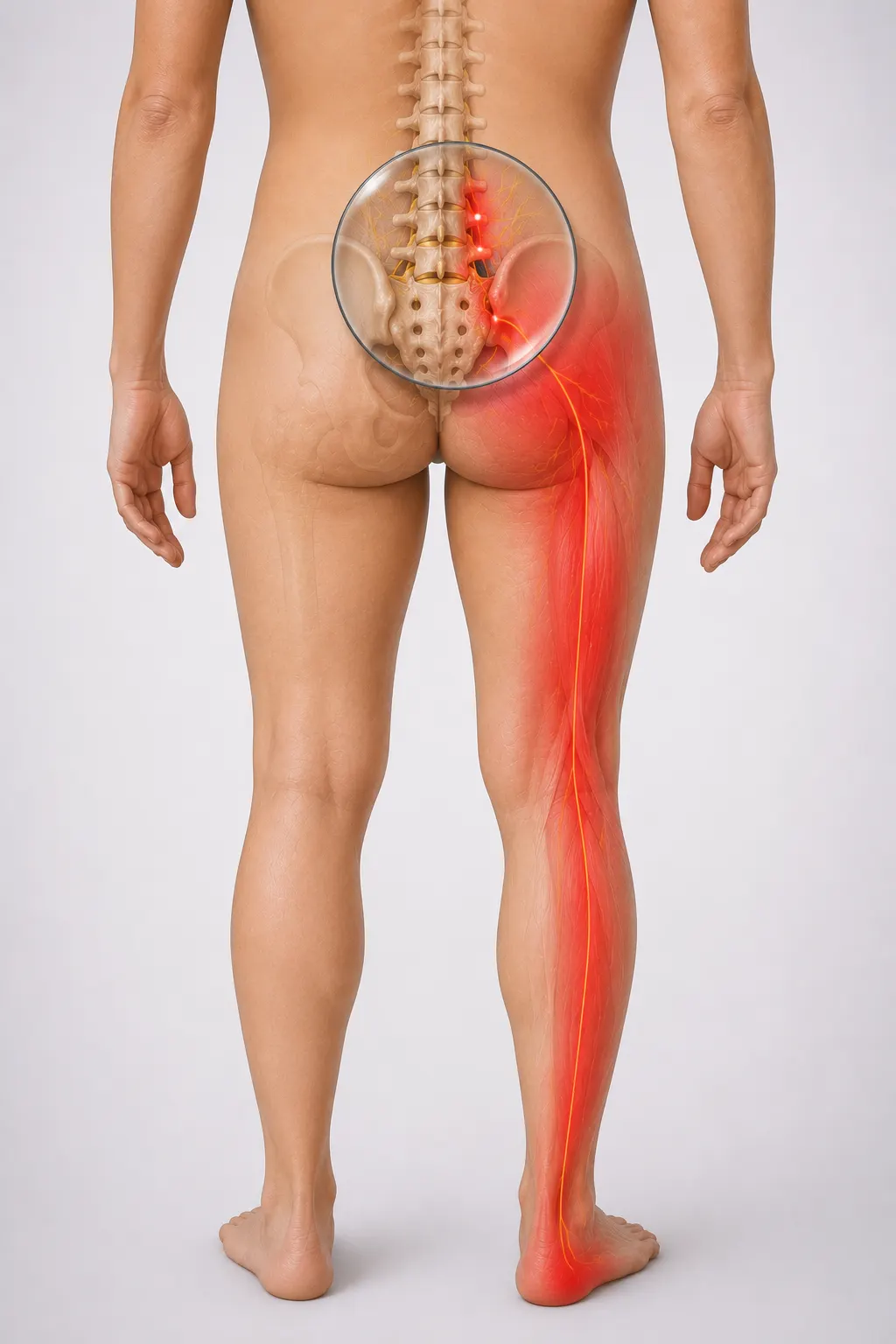
Magnifying glass over the lumbar spine — herniated disc with sciatica
Clinical picture

Nerve root under pressure.

In the case of a herniated disc disc tissue presses on a nerve root; this triggers nerve root inflammation with radiating pain into the leg (sciatica) or into the arm, often associated with tingling and numbness.

Most herniations improve conservatively over weeks — if pain persists, the question arises about further options.

Patients

What patients report.

Typical findings

From our patient consultations and the medical reports submitted.

  • Symptoms usually lasting several weeks to months
  • Pain radiating into the leg or arm
  • Tingling or numbness in the supply area
  • Exacerbation upon strain, coughing, sneezing
  • Often pain medication and surgery recommendation in the offing
Previous therapy

Almost always in this order.

  1. Pain medication and cortisone
  2. Physiotherapy / Back school
  3. Periradicular injections (PRT / epidural infiltration)
  4. Disc surgery
Standard therapies in focus

What standard therapies really achieve.

Conservative therapy: Time heals the majority — but not all.

About 80–90% of lumbar herniated discs regress spontaneously within six to twelve weeks; even sequestered herniations can shrink significantly radiologically. The basis of conservative care is active movement, targeted physiotherapy, and NSAIDs when required — bed rest is obsolete and worsens the outcome. Systematic reviews show a small to moderate short-term effect for NSAIDs in sciatica compared to placebo; for opioids, there is no superior benefit alongside relevant side effects. Despite regression on MRI, functional limitations, tingling, or residual pain remain in some patients; a clearly time-limited conservative trial (generally 6–12 weeks without red flags) is evidence-based standard. With increasing neurological deficits, bladder or bowel dysfunction, the conservative strategy must be abandoned immediately.

Chiu CC et al. Rate of spontaneous regression, meta-analysis. Clin Rehabil 2015. PMID 25009200. — Rasmussen-Barr E et al. NSAIDs for sciatica. Cochrane Database Syst Rev 2016;10:CD012382. — Hahne AJ et al. Non-surgical treatment for LDH: systematic review. Spine 2010;35(11):E488–504.

Injections (PRT / epidural infiltration): limited relief, only short-term.

Periradicular and epidural cortisone infiltrations (PRT, transforaminal, interlaminar, caudal) are intended to dampen perineural inflammation at the compressed nerve root. The Cochrane Review (Oliveira 2020) and other meta-analyses show a small, short-term effect on leg pain and function—predominantly up to four weeks; the effects are mostly not clinically relevant and cannot be robustly demonstrated beyond six months. Additional effects of cortisone compared to local anaesthetic alone are minor; an influence on the subsequent decision for surgery is not consistently proven. Rare but serious complications (especially transforaminal, particulate cortisone: neurological events) are documented, which is why image-guided technique and non-particulate cortisone are recommended. Useful as a bridge during severe radicular pain—no substitute for a long-term strategy.

Oliveira CB et al. Epidural corticosteroid injections for lumbosacral radicular pain. Cochrane Database Syst Rev 2020;4:CD013577. — Pinto RZ et al. ESI for sciatica: SR/MA. Ann Intern Med 2012;157(12):865–877. — Bicket MC et al. Epidural steroid safety review. Reg Anesth Pain Med 2015.

Surgery: good short-term effect—one in five to six patients undergoes follow-up surgery.

Disc surgery—usually performed as microsurgical discectomy or minimally invasive endoscopic technique—is indicated in cases of paralysis, cauda equina syndrome, or persistent unbearable pain for more than three months. Short-term results are good: 78–95 % of patients report a significant improvement in symptoms 1–2 years after the procedure. Long-term data refine this picture: in large cohorts with 10-year follow-up, the overall reoperation rate is between 16.5 % and 22.1 %; a recurrence of the herniated disc in the same segment is the most common cause (approx. 10 %). About 30–70 % of those operated on report residual symptoms of varying severity in long-term studies—an aspect that is often overlooked in preoperative counselling. Surgery is an established and in many cases useful procedure when clearly indicated; given the recurrence and long-term rates, it should—except in absolute indications—only be considered after a sufficiently long conservative trial.

Aihara T et al. 10-year follow-up. J Clin Neurosci 2022. PMID 34929635. — Kim CH et al. Nationwide sample cohort, 10 years. Spine 2019. PMID 30973508. — Rushton A et al. BMC Musculoskelet Disord 2018. PMC6134506.

Natural history

The body often resorbs herniated discs itself.

MRI longitudinal studies show: the larger and more displaced the disc fragment, the stronger the pain, but also the more likely the spontaneous regression under conservative therapy.

93 %Sequestrated discs
70 %Extruded discs
52 %Protrusions
13 %Bulging

The process takes weeks to months and is mediated by inflammation and remodelling processes in the epidural space, leading to the resorption of the disc tissue. This is a strong argument for initially treating acute disc herniations conservatively—provided there are no absolute indications for surgery such as paralysis or cauda equina syndrome—and giving the body time for its own healing capacity. 

Rashed S et al. Predictive factors for spontaneous regression, SR/MA. J Neurosurg Spine 2023;39(4):471–479. PMID 37486886. — Chiu CC et al. Probability of spontaneous regression, SR. Clin Rehabil 2015;29(2):184–195.

Where we make the difference

Periradicular injections often only work for a few weeks, and disc surgery—absent signs of paralysis—is usually only considered after a longer conservative trial.

Axomera for disc herniation and sciatica.

The herniated disc fragment compresses the nerve root; a perineural acidosis—local acidification—develops around the affected root, which additionally sensitises the pain fibres and makes the nerve root hyperexcitable. At the foramen, where the nerve root exits the spinal canal, this region is near enough to the surface to be targeted specifically.

Axomera focuses on this nerve root region: computer-controlled electrical signals in the dimension of cellular electrical fields are placed millimetre-precisely at the foramen and along the course of the nerve in the leg. The goal is to buffer the acidosis, relieve the nerve root, and reduce its hyperexcitability—it does not remove the disc herniation itself.

This neurophysiological hypothesis is empirically supported by many patient histories (real-world data), not by controlled studies; as with other indications, around 20–30 % of those treated do not respond. In the case of increasing paralysis, sensory disturbances, or bladder and bowel dysfunction, an immediate surgical assessment is necessary — Axomera is not a substitute in such cases.

How inflammation and pain are connected →
„
We treat one level deeper — where the body regulates inflammation and healing itself.
Prof. Dr. Albrecht Molsberger
— Prof. Dr. Albrecht Molsberger · Developer of Axomera therapy, medical director

Axomera is an internationally patented bioelectrical procedure.

How Axomera therapy works →
Our approach

How we proceed with you.

Every therapy requires its own examination—with us, this is the Axomera diagnostics  as the basis for the precise Axomera therapy.

Axomera diagnostics
  1. Secure the diagnosis and check the influence of taken medication
  2. Millimetre-precise examination—localise pain points at the affected nerve root and segment region
Axomera therapy
  1. 4–6 Axomera treatments, targeted at these points
  2. Goal: significant reduction of pain and muscle weakness.
  3. In favourable cases: long-term freedom from symptoms and avoidance of surgery.

Aims & course of treatment. We cannot guarantee a specific result — the progression is individual. Depending on the course of the condition, fewer or more treatments may be required.

Axomera modulates cellular signals to control inflammation and regeneration. The aim is to interrupt chronic inflammation and initiate higher-quality regeneration.

Patients report

Individual cases.

For three years I had lumbar pain radiating down into my lower leg. I could no longer play table tennis. Injections, nerve root blocks, acupuncture, painkillers, physiotherapy—hardly any improvement. My doctor then used three Axomera treatments—with significant improvement one day after the first treatment. Very good procedure. I wish I had used it much earlier.
Lumbar disc herniation with sciatica

“Three treatments, significant improvement after day one.”

Patient, 77—distinct individual case history.

Documented individual cases, with patient consent. Individual outcomes differ.

Is Axomera right for me? Initial telephone assessment →
Your treatment team

Who treats you.

Your practitioners
Prof. Dr. med. Albrecht Molsberger

Prof. Dr. med. Albrecht Molsberger

Developer of Axomera therapy · Medical Director

As the developer of Axomera therapy, he oversees the indication and is involved in your treatment personally upon request. His experience in conservative pain medicine informs the planning of your treatment series.

Career history
  • Specialist in Orthopaedics; additional qualifications in Sports Medicine, Acupuncture, Naturopathy
  • Habilitation 2005, adjunct professorship for Orthopaedics at Ruhr University Bochum
  • Conception and management committee of the GERAC studies (German Acupuncture Trials)
  • Development of Axomera therapy since 2008
Dr. med. Philipp Schröder

Dr. med. Philipp Schröder

Doctor, orthopaedics & trauma surgery (in specialist training)

Performs your Axomera treatment and accompanies you throughout the entire treatment series. He reviews your findings and assesses whether the procedure is suitable for you. He also participates in the technical development.

Career history
  • Doctor, orthopaedics & trauma surgery (in specialist training); medical degree, Heinrich Heine University Düsseldorf, 2020
  • Doctorate magna cum laude, Ruhr University Bochum (2021): Pain localisation in cluster headache
  • Expert courses in Ultrasound in Pain Medicine (DEGUM curriculum, level I); Expert course in Sports Medicine
  • Technical co-development of Axomera therapy; co-founder of Columbus Health-Products GmbH
Further practitioner
Jonas Becker

Jonas Becker

Doctor, Specialist in Orthopaedics and Trauma Surgery

Organises your previous findings, performs Axomera diagnostics, and accompanies you throughout the entire treatment series. He reviews your findings and, based on his experience, assesses whether the procedure is suitable for you.

Contact · Online reception

Clarify first. Then travel.

Three ways to reach us, around the clock, directly here on the site. For each, you can upload doctor's letters, findings, and MRI images at the same time — encrypted into your file, reviewed by a doctor before we speak.

01 · Telephone

Briefly check if it's a fit.

Ten minutes with a doctor. Free of charge.

  • ·For those who are unsure
  • ·Upload findings beforehand
  • ·No obligation
Select phone appointment →
02 · Video

Consultation on findings without the travel.

Medical assessment via video.

  • ·For patients traveling from further away
  • ·Second opinion before making a decision
  • ·According to GOÄ, amount visible upon booking
Book video appointment →
03 · Practice

Everything in one appointment.

Examination, Axomera diagnostics, plan, costs.

  • ·For all who wish to visit
  • ·The direct route for distances up to about 100 km
  • ·Bring or upload findings
Book appointment →

Are you traveling from further away? Start with 01 or 02. Only when it is clear that Axomera is suitable for you do we plan the journey — condensed into a few days. Available internationally as a concierge service upon request.

Prefer personal contact? Call: +49 211 866880

Our practice treats exclusively by prior appointment.

The telephone initial assessment is not a treatment and does not replace an examination. Whether Axomera is suitable for you will be decided after a medical examination.